
Mekong–ROK Forum Marks Decade of Development, Charts Path Forward
Hanoi, Viet Nam – May 14, 2025. In a celebration of over 10 years of regional development work, Mekong Institute (MI), sponsored by the Ministry of Foreign Affairs of the Republic of Korea (ROK) and the Ministry of Foreign Affairs of Viet Nam, convened the first-ever Mekong–ROK Cooperation (MKC) Forum. Held under the theme “Advancing Regional Development and Partnerships,” the milestone event builds on past successes to strengthen partnerships, identify future priorities, and shape the next phase of the Mekong–ROK Cooperation framework.
Commemorating years of impactful collaboration, the forum showcased project outcomes under the Mekong–ROK Cooperation Fund (MKCF)—a development mechanism established in 2013 to strengthen ties between Cambodia, Lao PDR, Myanmar, Thailand, Viet Nam, and the ROK. The MKCF addresses the region’s evolving needs by supporting projects that are regional in scope or benefit multiple Mekong countries. MI, as the Fund Coordinator, oversees project selection, fund disbursement, implementation monitoring, and coordination with national governments.
Reflecting on progress
In his plenary remarks, MI Executive Director Mr. Suriyan Vichitlekarn stressed that strengthening capacity, coordinating policy, and fostering cross-border collaboration remain central to regional progress enabled by MKCF. “MKCF projects are not just about implementation—they are bridges between policy and practice, ambition and action. And we have moved from simply disbursing funds to becoming a catalyst for meaningful development cooperation and partnership,” said Mr. Suriyan. He added that the path forward for MKCF calls for stronger regionality, greater private sector engagement, and innovations that uplift MSMEs and communities alike.
Ms. Nguyen Bich Thuy, Deputy Director General of the Economic Diplomacy Department at the Ministry of Foreign Affairs of Viet Nam, welcomed participants to Hanoi, sharing that Viet Nam is honored to co-host the forum as part of the country’s co-chairmanship of the Mekong–ROK Cooperation this year. She noted that the senior officials of the Mekong–ROK Cooperation are eager to hear insights from the ground, viewing them as invaluable inputs for refining implementation models and shaping the roadmap for a new action plan. “We know there is more we can achieve—more to do to ensure that the benefits of this cooperation reach even further: into more communities, more sectors, and more lives,” she said.
In response to the growing demand for sustainable development in the Mekong region, Mr. Lee Dong-gy, Director General for ASEAN and Southeast Asian Affairs at the Ministry of Foreign Affairs of the Republic of Korea, reaffirmed the ROK’s continued commitment to strengthening its contributions to MKCF. He credited the success of MKCF to the collective efforts of all stakeholders, particularly the MKCF Project Implementing Agencies (PIAs). “I would like to recognize the exemplary role of the project implementing agencies—the real drivers of our ROK–Mekong cooperation. It is your dedicated work that brings our cooperation to life,” he said, speaking to more than 170 event participants, including representatives of MKCF PIAs, ministries of foreign affairs, foreign missions in Hanoi, line ministries across 7 priority sectors, development partners, universities and research institutes, private sector actors, and members of the media from Mekong countries and ROK. In his remarks, Mr. Lee also commended MI for its excellent work as the MKCF Secretariat.
Monitoring and demonstrating results
Sharing an overview of the mechanism’s progress and achievements, MKCF Director Mr. Madhurjya Kumar Dutta, who also heads MI’s Trade and Investment Facilitation (TIF) Department, discussed how the new Mekong-ROK monitoring and evaluation framework and system are tracking project results and outcomes. “This is basically about ensuring accountability—seeing where the money is going and what results we are creating. Through this system, we’re able to identify and showcase outcomes, as well as track the progress of interventions. We want to observe which outcomes we aim to sustain. Different projects yield different results—not all are scalable or widely applicable—so we need to assess what is realistically possible,” Mr. Dutta explained. He also noted that scaling and replicating MKCF successes amplifies impact not only in one country but across the entire Mekong region.
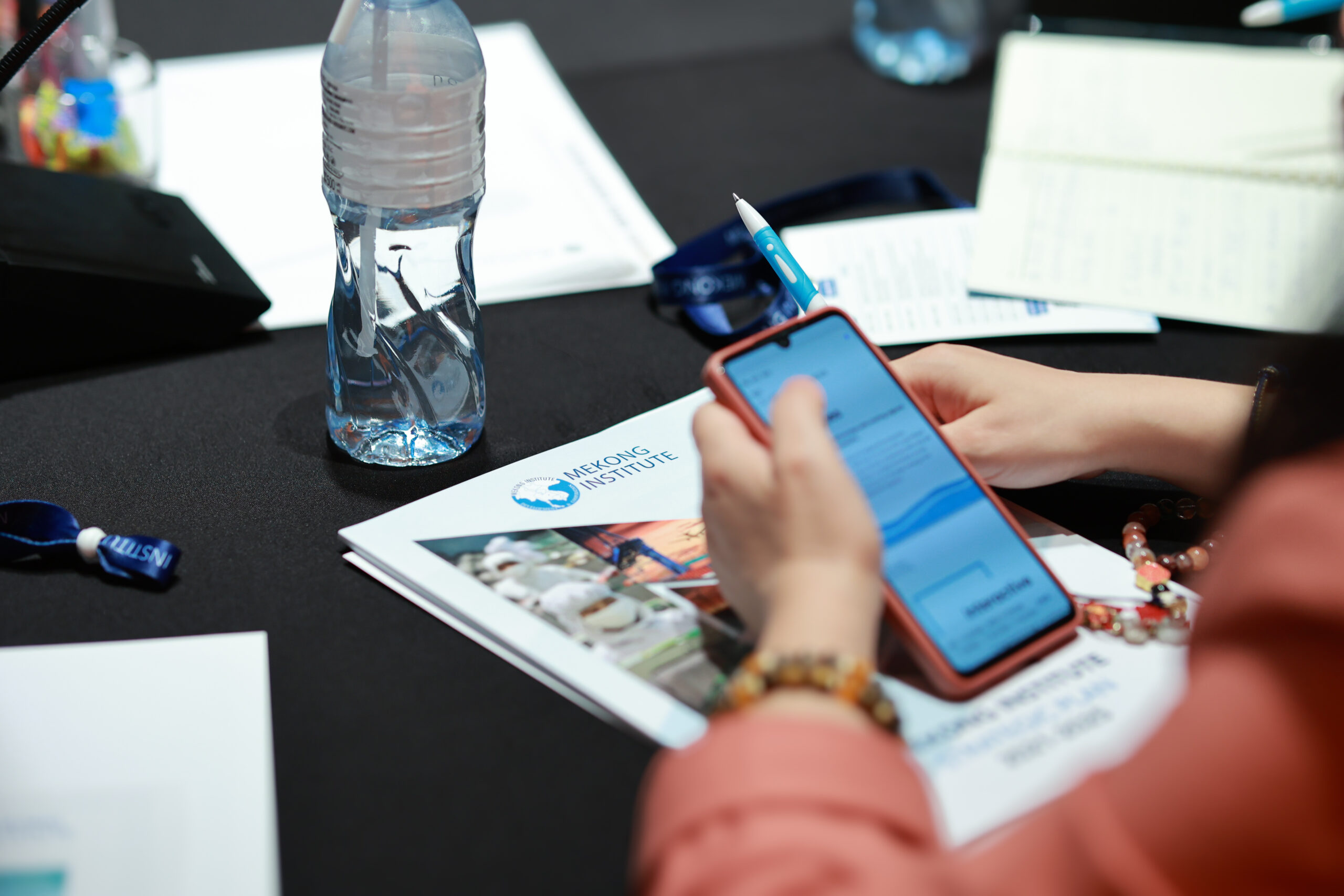
A highlight of the forum was the MKCF Project Exhibition, which featured around 39 innovative initiatives through publications and multimedia displays. It was designed not only to highlight the tangible results of MKCF-supported projects, but also to foster meaningful connections among PIAs, development partners, private sector actors, and academic institutions. Through the exhibition, the forum created opportunities to explore new funding avenues that can help sustain the long-term impacts of ongoing initiatives. Just as importantly, the exhibition served as a space for project teams to learn from each other’s experiences and approaches—laying the groundwork for stronger collaboration and more effective implementation moving forward.
The forum also saw the rollout of MKCF’s new knowledge products, including a Directory of MKCF Projects (2013–2025) and a compilation of Stories of Change—both presenting achievements from Calls 1 to 8 and the differences made by MKCF-supported projects. These aim to serve as catalysts for continued collaboration, innovation, scaling, and impact in the years ahead.
Shaping what’s next
The forum’s breakout discussions elicited stakeholder inputs that will inform the next Mekong-ROK Plan of Action, enabling future sectoral strategic roadmaps that are co-created, aligned with national and regional plans, and aimed at advancing the Sustainable Development Goals (SDGs).
As this year marks the 5th anniversary of the Mekong–ROK Strategic Partnership, the Ministry of Foreign Affairs of Viet Nam, in coordination with the Ministry of Foreign Affairs of ROK, convened the Mekong–ROK Cooperation Senior Officials Meeting (MKC SOM) in Hanoi. The meeting was held a day before and in conjunction with the MKC Forum. Attended by senior officials from the six member countries and MI representatives, it underscored the MKC’s vital role in narrowing development gaps and promoting economic integration in the subregion. It highlighted MKC’s effectiveness in raising international awareness, mobilizing private sector engagement, and translating vision into results through the MKCF.
Since its inception, the MKCF has supported 61 projects and contributed a total of USD 32.66 million. ROK has continuously increased funding, covering seven priority sectors, as defined in the Mekong–ROK Plan of Action 2021–2025: Agriculture and Rural Development, Infrastructure, Environment, Culture and Tourism, Human Resources Development, Information and Communication Technology, and Non-traditional Security Challenges. To date, 22 projects have been successfully completed.
According to a news story from the Ministry of Foreign Affairs of Viet Nam, the MKC SOM plans to resume the Mekong–ROK Summit and develop the MKC Plan of Action for 2026–2030. Member countries and the ROK agreed to expand cooperation into new areas—such as smart connectivity and cultural industries—while reinforcing collaboration in climate resilience, water-food-energy security, human resource development, and tourism. The action plan is expected to be adopted in principle at the MKC Ministerial Meeting in July 2025.
For event materials and more details about the forum, visit the event webpage at https://mekonginstitute.org/mekong-republic-of-korea-cooperation-forum-2025/
Media Contact
Ms. Wen Hao
MKCF-PRIME Project Manager
Trade and Investment Facilitation Department (TIF)
Mekong Institute
📧 [email protected]
Mekong Institute
123 Mittraphap Rd., Muang District, Khon Kaen 40002, THAILAND
📞 Tel: +66 (0) 4320 2411
📧 Email: [email protected]


