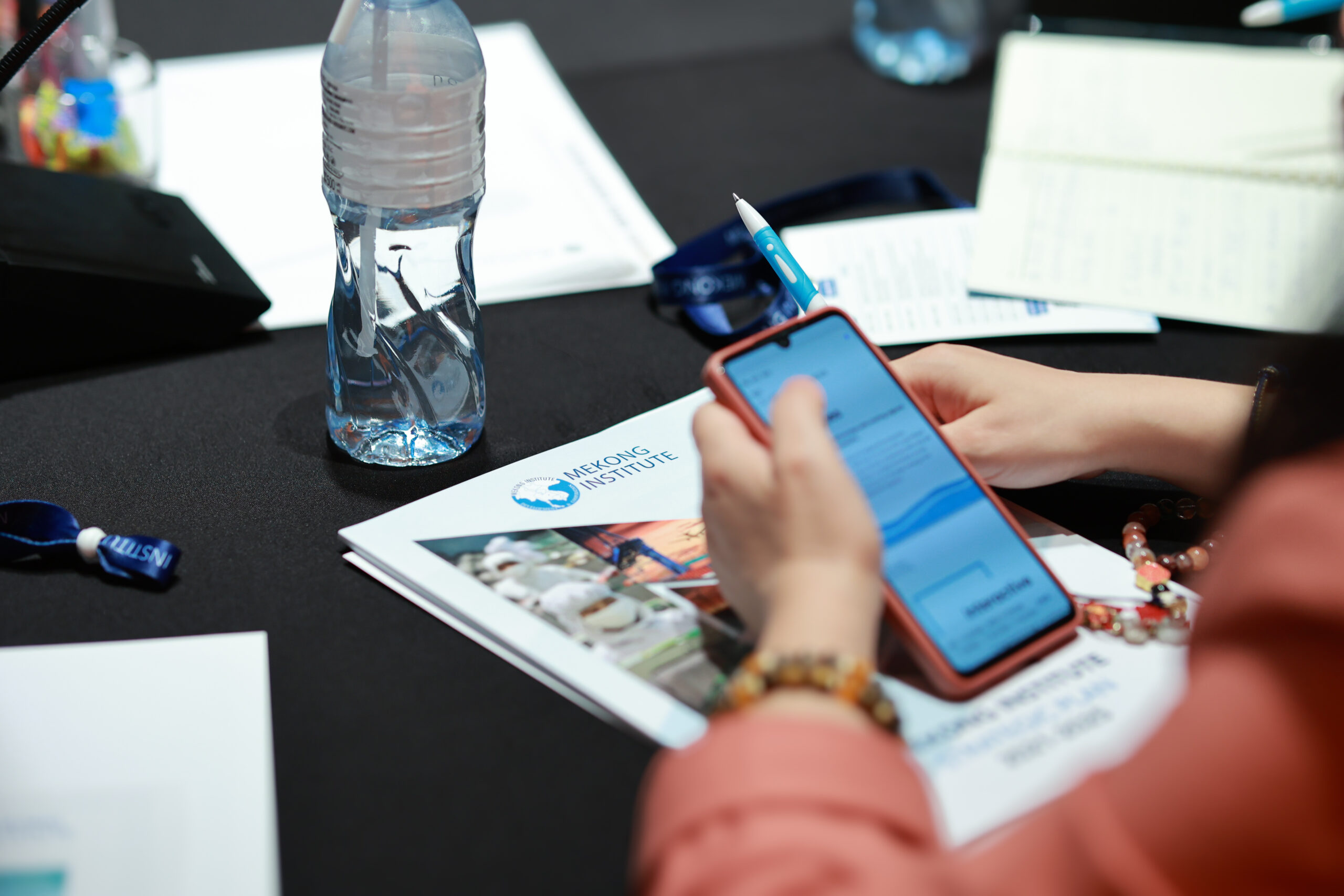

Amid shrinking global financing for development initiatives, the Mekong Institute (MI) and the Central Asia Regional Economic Cooperation (CAREC) Institute are exchanging strategies to mobilize resources critical for sustaining and scaling gains in both the Greater Mekong and Central Asia subregions. Around 40 participants from the two organizations and other stakeholders convened online on April 24, 2026, for a peer learning webinar aimed at supporting continuous institutional development and deepening cooperation between the two subregions.
Mr. Suriyan Vichitlekarn, Executive Director of MI, noted that although the two subregions are among the most advanced in Asia, important gaps remain, making sustained capacity-building support for member countries more critical than ever.
“Regional cooperation and integration, particularly in Asia, have delivered significant progress in connectivity, cross-border mechanisms, and people-to-people exchange. Yet much remains to be done, as member countries continue to demand better and more responsive services. At the same time, new and emerging challenges could undermine ongoing initiatives,” said Mr. Suriyan. He added that enhancing the role, contribution, and capacity of subregional institutions such as MI and the CAREC Institute will help ensure that their services remain relevant and high-quality, enabling broader contributions to development across Asia.
Mr. Charymuhammet Shallyyev, Director of the CAREC Institute, stressed that regional knowledge institutions like MI and the CAREC Institute play a vital role in evidence-based policymaking, capacity building, and regional cooperation, and that the challenges they face are not unique to any single institution. “The collaboration between our two institutions reflects a shared commitment not only to regional development, but also to the institutional sustainability that makes development possible. By learning from one another, we can accelerate our progress and ultimately enhance the services we provide to our member countries and communities,” he explained.
The webinar featured an exchange of existing practices and lessons learned from each organization’s resource mobilization efforts. From MI, Mr. Suriyan and Ms. Anusara Tanpitak, MI Communication and Knowledge Management (CKM) Manager, shared practical principles and tips such as being clear about institutional goals, pursuing partnerships for results, identifying shared value among partners and donors, and moving beyond the view that resources always mean cash.
“Support can come through in-kind contributions, technical expertise, speakers, visibility, political backing, or even discounted services that help reduce costs for specific activities,” shared Ms. Tanpitak.
Mr. Josh Hu, Chief of Finance and Administration Division of the CAREC Institute, echoed the importance of remaining responsive to the needs of member countries while maintaining the organization’s strategic focus in resource mobilization efforts. “No matter what kind of project funding our partners can provide, we will continue to focus on our strategic priorities in transport, trade, and investment,” Mr. Hu said. “We need high-quality knowledge products and services, and we need a high-performing team. That is the foundation of our fundraising activities. We aim to bring together research and knowledge, capacity building, and knowledge sharing, while making these services more responsive to the needs of our member countries.”
Other interventions emphasized that successful resource mobilization depends on credibility, adaptability, and strategic partnerships. Ms. Nigar Islamli, Programs Director at the Center for Economic & Social Development (CESD), an independent economic think tank in Azerbaijan, highlighted the importance of combining research, advocacy, and capacity building with strong internal systems, transparent governance, and diversified funding sources to ensure long-term sustainability in a complex and shifting funding environment.
Dr. Alex Smajgl, Managing Director of the Mekong Region Futures Institute (MERFI), urged organizations to view opportunities from the donor’s perspective, focus on delivering solutions rather than selling methods, remain innovative and reliable, understand funding mechanisms deeply, and build genuine partnerships with governments, donors, and peer institutions.
The resource mobilization webinar was the first in a series of institutional peer learning sessions between MI and the CAREC Institute. Two upcoming sessions will focus on governance, as well as program and project design.
About CAREC Institute
The CAREC Institute is an intergovernmental organization that promotes economic cooperation across Central Asia and along the Silk Road through knowledge generation, capacity building, and knowledge sharing. Headquartered in Urumqi, People’s Republic of China, the institute is jointly governed by 11 member countries and serves as the knowledge support arm of the CAREC Program.


